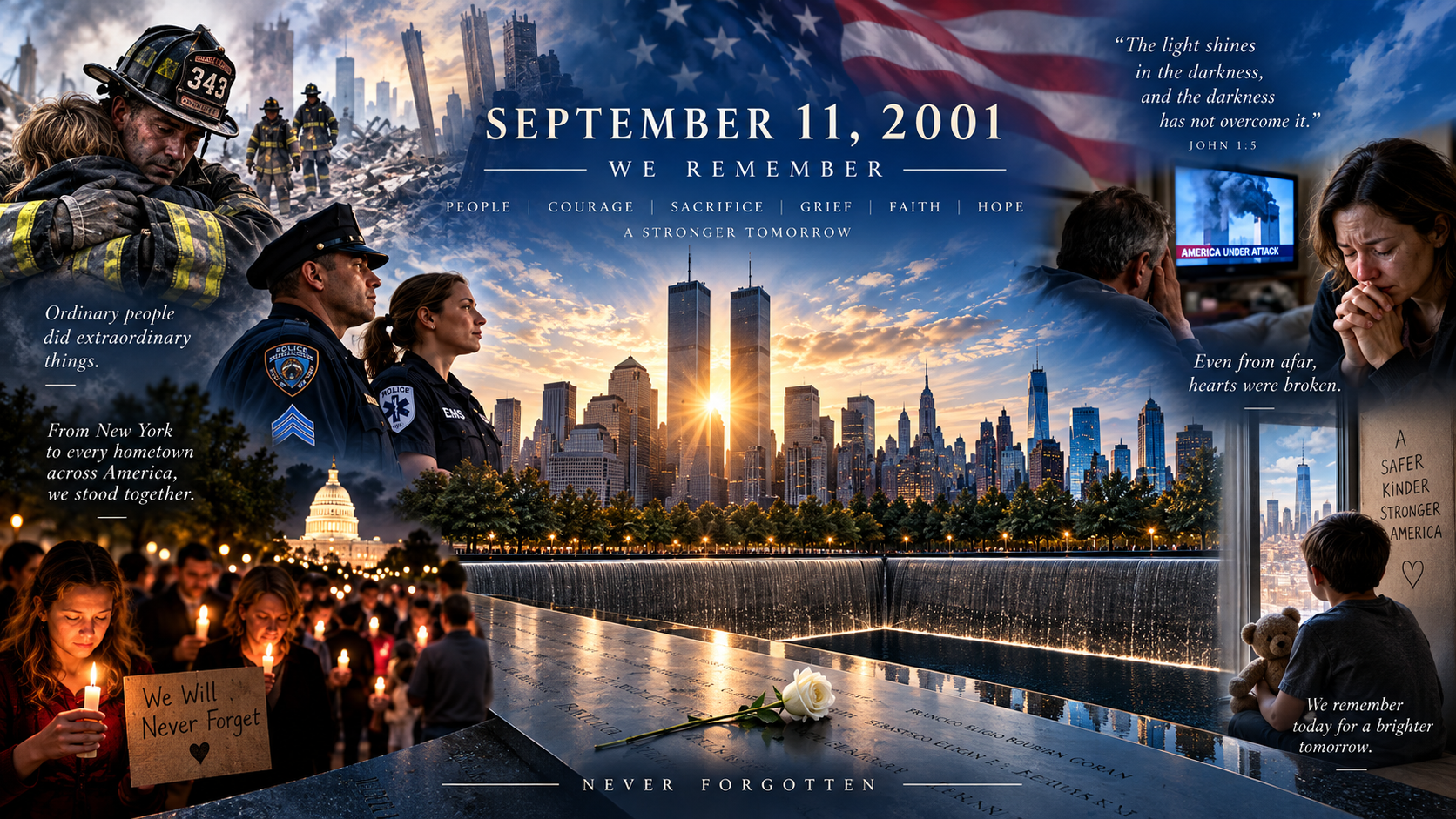
Twenty-five years later, we remember the lives lost, the courage displayed, the families forever changed, and the hope that remains.
This week America will mark the 25th anniversary of 09/11. A quarter-century has passed since the terrorist attacks sent shockwaves through American communities and fundamentally changed the way we understood the threats facing our country. For those of us old enough to remember that morning, September 11 is more than a historical event. The details, the feelings, and the emotional aftermath remain part of our memories in much the same way that previous generations remembered where they were when John F. Kennedy was assassinated or when Pearl Harbor was attacked.
The attacks changed more than our sense of security. They changed American government, law enforcement, national defense, and the relationship between them. Threats that had seemed distant suddenly appeared much closer to home. Counterterrorism became part of the domestic law-enforcement mission, government agencies reconsidered preparedness, and new training, equipment, and tactical capabilities became available to police departments. The country understandably wanted greater security and some assurance that an attack of that magnitude would never happen again.
That response also raised questions that remain important twenty-five years later. Standing at the Ground Zero Memorial in 2019, wearing the uniform of the sheriff's department I worked for, I remember asking them. How does a free country respond to people determined to destroy it without allowing them to weaken the principles upon which that country rests? I had argued in some of my graduate research that maintaining due process and constitutional protections in the fight against terrorism is not evidence of weakness. It says something about America's commitment to justice precisely when maintaining that commitment is difficult. Terrorism should never be permitted to accomplish indirectly what terrorists could not accomplish directly by causing us to surrender through fear the principles they attacked.
But September 11 cannot be remembered primarily as a national-security event or a matter of public policy. People died. Families were shattered. First responders encountered human suffering on a scale almost impossible to comprehend. The events became history for the country, but for thousands of families they became something much more personal.
Tragedy has a way of consuming identity. In criminal justice and emergency services, people can quickly become identified by what happened to them: the homicide victim, the fatality, the casualty. The people who loved them remember something else. They remember the laugh, an irritating habit, a favorite meal, a birthday, an old argument that now seems ridiculous, or the chair where the person always sat. Remembering the life rather than only the death restores something violence threatens to take away—the personhood of the one who died.
That matters when we remember September 11. The enormity of the attacks can cause us to think in numbers, buildings, airplanes, timelines, and historical consequences. Families do not grieve statistics. They grieve people. Twenty-five years later, there are families for whom September 11 is still connected to a particular face, voice, relationship, empty place at a table, or life that continued in a direction nobody expected.
My understanding of that changed when mass violence struck my own community. Places associated with ordinary community life suddenly became places associated with mass death. I knew many of the responding police officers and sheriff's deputies, and I had served as chaplain to some of them. People close to me knew victims or their families. Friends who knew me as a minister and chaplain began reaching out, and some of them were looking for answers.
I did not have them.
There is a particular humility in admitting that. Chaplains study theology because we believe theology matters. I believe God is sovereign. I believe Scripture tells the truth about evil, suffering, death, judgment, redemption, and hope. But those convictions do not give me knowledge God has not revealed about why a particular person dies in a particular act of violence while another person survives.
Religious platitudes about “God's will” seemed painfully inadequate in the aftermath of the violence in my own community. They could not explain why one family awakened the next morning intact while another would never gather in quite the same way again. They could not explain why one person survived and another did not. Christian faith does not require us to pretend that we possess access to the hidden purposes of God.
We can know God without knowing why God permitted every event. We can affirm providence without claiming access to the secret counsel of God, and we can proclaim hope without inventing explanations for suffering. Some questions deserve more respect than a slogan. Why this family? Why this person? Why did God allow it? Where was God?
Scripture itself does not treat grief as a problem requiring immediate explanation. Job was never given access to all the events behind his suffering. The Psalms give suffering people language for lament rather than pretending faithful people never ask why. Jesus stood at the grave of Lazarus and wept even though He knew resurrection was moments away. Christian hope therefore has room for grief that has not resolved itself into understanding.
That is an important part of how I think Christians should approach September 11. There may never be a satisfying explanation for why particular people died that morning. We do not need to manufacture one. What Christianity does tell us is that God has not remained distant from human suffering. Christ entered it. He was betrayed, falsely accused, brutalized, and killed. He wept beside a grave and ministered to brokenhearted people. In His resurrection, death itself was placed under judgment.
The Gospel, then, is not merely a message for peaceful days. It speaks to a world shattered by sin and death. Every tragedy bears witness to the brokenness of creation, but compassionate ministry also bears witness to the God who entered that brokenness through His Son. Christian faith permits us to grieve honestly while still possessing hope. Tears and hope are not contradictions.
September 11 also reminds us of the people whose vocation places them repeatedly near tragedy. Police officers, firefighters, emergency medical personnel, dispatchers, and others working in public safety are not merely witnesses to human suffering. They experience it as part of their work. They make decisions while others panic, enter dangerous situations while others flee, and remain composed while families experience some of the worst moments of their lives.
The emotional control necessary to perform that work should never be mistaken for immunity from suffering. Strength and suffering can exist together. An experienced first responder may appear calm and fully capable while carrying memories that return years later. Dispatchers can remember desperate voices belonging to people they never met. Emergency medical personnel can remember faces long after names have been forgotten. The burdens are real even when they remain invisible.
That deserves particular attention when remembering September 11 because the courage displayed that morning did not erase the humanity of those who displayed it. We rightly remember the men and women who moved toward danger while others were trying desperately to escape it. We should also remember that people who arrive when everyone else is having the worst day of their lives eventually accumulate difficult days of their own. An emergency may end while its effects continue for years.
This is one reason remembrance cannot be limited to ceremony. The questions after a tragedy change as time passes. Anger can emerge after numbness. Guilt can appear after practical responsibilities lessen. Spiritual questions sometimes surface only after friends stop calling and the house becomes quiet. Twenty-five years have passed since September 11, but the passage of time does not mean every consequence of that morning belongs safely in the past.
Christian remembrance should therefore make room for both justice and mercy, grief and hope, courage and suffering. Justice matters. Victims matter. Those who responded matter. The people who carried the consequences afterward matter. Christian grace should never require minimizing evil or pretending that devastating acts did not leave devastating consequences. The cross allows us to hold justice and mercy together because both matter to God.
September 11 showed us the reality of human evil. It also showed us courage, sacrifice, duty, compassion, and the willingness of people to place themselves in danger for strangers. Those realities belong beside one another in our memory of that day. We do not honor the dead by reducing them to statistics, and we do not honor those who served by imagining that courage made them invulnerable.
Twenty-five years later, the generation that remembers September 11 firsthand is increasingly responsible for telling its meaning to a generation that knows it only as history. We should tell the truth about the evil committed that morning. We should tell the truth about the courage displayed in response. We should tell the truth about the years of consequences that followed. And Christians should be willing to tell the truth about the limits of our own understanding while refusing to surrender the hope at the center of our faith.
There may be questions about September 11 that we will never answer satisfactorily in this life. Faith does not require us to pretend otherwise. Christian hope rests somewhere else. God did not remain distant from human suffering but entered it in Jesus Christ, and the resurrection declares that suffering, evil, and death do not possess ultimate authority.
That is enough reason to remember September 11 with sorrow. It is also enough reason to remember it with hope.
