By Tim Lajoie, BCC
Chaplain, Author & Educator
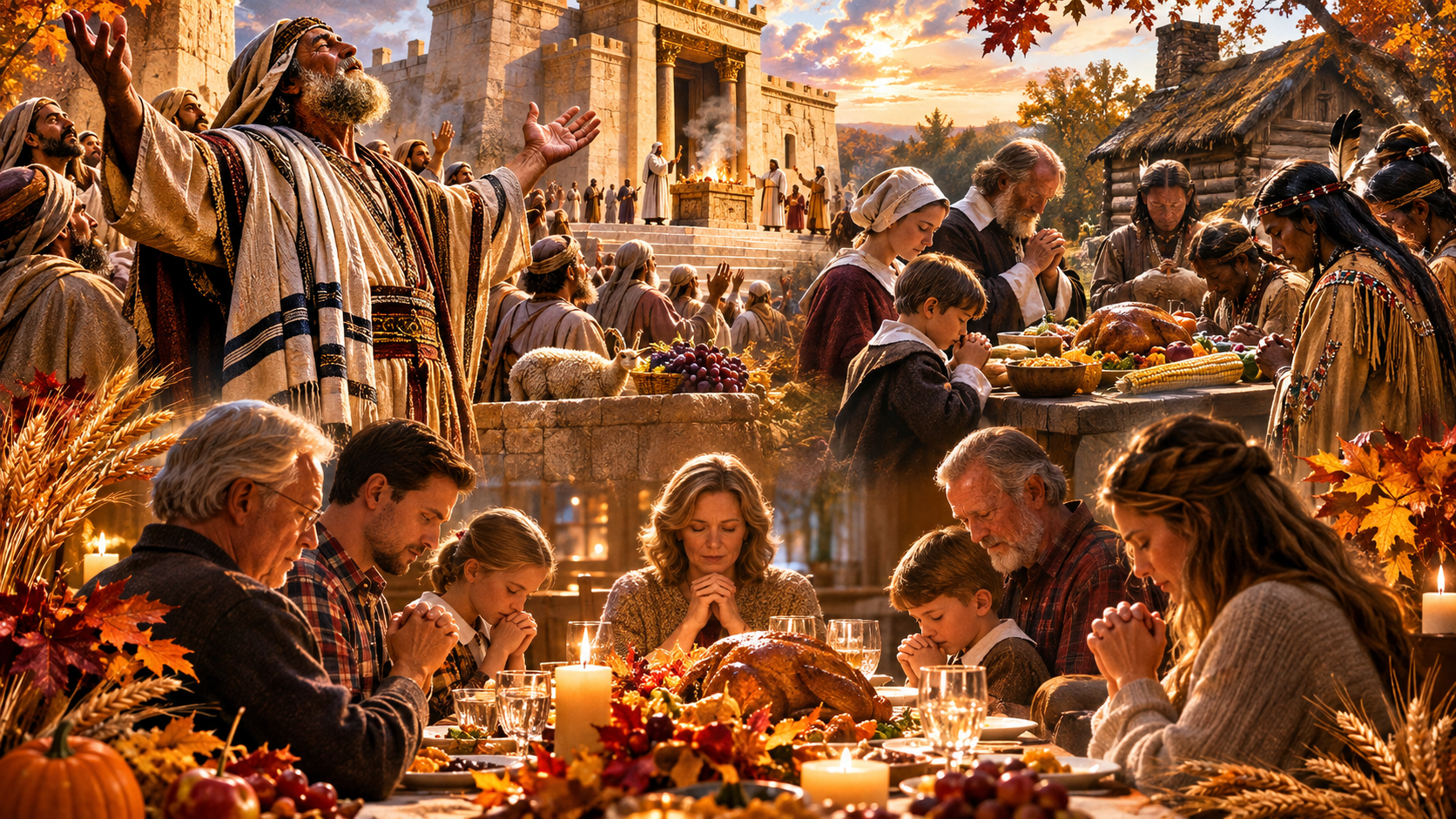
Across the centuries, the heart of Thanksgiving remains unchanged: acknowledging the goodness of God, remembering His blessings, and giving Him the praise He deserves.
This Thursday, families across America will gather around tables, share meals, renew acquaintances, and reflect upon the blessings of the past year. Thanksgiving is a wonderful American tradition, but I wonder how often we consider the distinction between being thankful for something and being thankful to Someone. There is a profound theological difference between the two, and it is a distinction worth recovering.
As Christians, our thanksgiving has a recipient. We acknowledge the goodness, mercy, provision, and sovereignty of Almighty God. Our gratitude is not merely a positive attitude toward life but an expression of our relationship with the Lord.
Psalm 100, a psalm of praise, reminds us of the proper object of our thanksgiving:
Enter into his gates with thanksgiving, and into his courts with praise: be thankful unto him, and bless his name. For the LORD is good; his mercy is everlasting; and his truth endureth to all generations. — Psalm 100:4–5
The Psalmist grounds our thanksgiving in the character of God Himself. His goodness, mercy, and truth are enduring realities, independent of the changing circumstances of our lives.
When Thanksgiving Is Difficult
Not everyone will approach Thanksgiving this year with a cheerful heart. There will be empty chairs at dinner tables. Some families will be facing uncertain medical diagnoses, financial hardship, broken relationships, or the painful consequences of decisions they wish they could undo. Others will spend the holiday in hospitals, nursing facilities, or correctional institutions, separated from the people they love.
The Apostle Paul wrote in 1 Thessalonians 5:18:
In every thing give thanks: for this is the will of God in Christ Jesus concerning you.
Notice that Scripture instructs us to give thanks in everything. We need not pretend that disease, death, injustice, or suffering are pleasant experiences. Christianity does not demand that we deny the realities of a fallen world to demonstrate the sincerity of our faith.
Perhaps nowhere in Scripture is this more powerfully demonstrated than in the life of Job. Having suffered the devastating loss of his children and his possessions, Job rent his mantle, shaved his head, fell upon the ground, and worshipped.
And said, Naked came I out of my mother's womb, and naked shall I return thither: the LORD gave, and the LORD hath taken away; blessed be the name of the LORD. — Job 1:21
Job's response was not an absence of grief. His outward expressions of mourning testified to the depth of his suffering. Yet even in his grief, he acknowledged the sovereignty of God and blessed His name. Scripture records that in all this Job sinned not, nor charged God foolishly.
There is a considerable difference between worshipping God for what He has given us and worshipping God for who He is. Job demonstrated that the latter need not cease when the former has been taken away. His circumstances had changed dramatically, but the God whom he worshipped had not.
Psalm 107 repeatedly recounts the experiences of people who found themselves in distress and cried out to the Lord. Its recurring refrain is a call to remember God's goodness:
Oh that men would praise the LORD for his goodness, and for his wonderful works to the children of men! — Psalm 107:8
The Psalmist does not ignore the hardships these people endured. Their suffering forms part of the testimony of God's mercy. Thanksgiving becomes an acknowledgment of the Lord's goodness in the context of life's difficulties.
We can grieve what we have lost while remaining grateful for what God has given. We can acknowledge our disappointment without abandoning our confidence in His goodness. Thanksgiving and sorrow are not incompatible expressions of the Christian life.
Learning to Recognize God's Goodness
Chaplaincy has afforded me a perspective on life that I might never otherwise have acquired. When your work regularly brings you into contact with suffering, you can become so accustomed to recognizing what is wrong that you overlook what is right.
Yet alongside that suffering are demonstrations of extraordinary courage, tenderness between family members, reconciliation after years of estrangement, renewed faith, and ordinary acts of kindness. Sometimes the most significant developments in a person's life occur so gradually that they escape our attention unless we are deliberately looking for them.
Thanksgiving teaches us to notice grace rather than merely trouble.
David writes in Psalm 103:
Bless the LORD, O my soul: and all that is within me, bless his holy name. Bless the LORD, O my soul, and forget not all his benefits. — Psalm 103:1–2
There is considerable wisdom in those words, forget not all his benefits. We are remarkably capable of remembering our disappointments while forgetting our blessings. Trouble commands our immediate attention, while the goodness we experience daily can become so familiar that we scarcely acknowledge it.
Consider how much of our ordinary existence we take for granted. The ability to walk independently, prepare our own meals, converse with someone we love, or enjoy the freedom to come and go as we please may seem unremarkable until those privileges are taken away.
A grateful heart recognizes the significance of these things while they are still ours to enjoy. We should not have to lose something before discovering its value.
When Our Prayers Become a List of Requests
In Philippians 4:6, Paul writes:
Be careful for nothing; but in every thing by prayer and supplication with thanksgiving let your requests be made known unto God.
How interesting that thanksgiving is included alongside our requests. God invites us to bring our burdens before Him, but our relationship with Him should not be defined exclusively by our needs.
It is easy to pray when we are frightened, when someone we love is sick, or when circumstances have moved beyond our ability to control them. But what about when the news is good? What about the prayers that have already been answered, the dangers from which we have been delivered, and the provisions we have received?
We ask because we lack, give thanks because we have received, lament because the world remains broken, and worship because God remains God within all of it.
A relationship with God that consists entirely of requests is missing something essential. Thanksgiving reminds us that He is worthy of our attention even when we have nothing immediate to ask of Him.
The Greatest Reason for Thanksgiving
The Psalmist asks a compelling question in Psalm 116:
What shall I render unto the LORD for all his benefits toward me? — Psalm 116:12
Later in the same psalm, he declares:
I will offer to thee the sacrifice of thanksgiving, and will call upon the name of the LORD. — Psalm 116:17
In studying the sacrificial system of the Old Testament, we discover that not every sacrifice was offered for sin. The peace offerings described in Leviticus provided opportunities for God's people to express gratitude, acknowledge His provisions, and enjoy fellowship with Him.
There is a beautiful New Testament application to this principle. As Christians, we understand that Jesus Christ accomplished what we could never accomplish for ourselves. Through His death upon the cross, He provided the means of our reconciliation with God.
Colossians 1:20 speaks of Christ:
And, having made peace through the blood of his cross, by him to reconcile all things unto himself...
The Christian's sacrifice today is not an attempt to purchase that peace. It is an expression of gratitude for the peace that Christ has already secured.
This is the foundation of Paul's appeal in Romans 12:1, that we present our bodies as a living sacrifice unto God. Christian service is not a religious checklist by which we earn God's acceptance. It is our reasonable response to His mercy.
Perhaps the measure of our thanksgiving is revealed less by what we say around the dinner table than by what we are willing to give of ourselves throughout the remainder of the year. Our willingness to serve, forgive, extend mercy, and minister to others reflects something of our understanding of what we ourselves have received.
Thanksgiving Beyond Thursday
There is nothing wrong with enjoying a good meal, watching a football game, or spending an afternoon with family. These are blessings in themselves. But Thanksgiving ought to leave an impression upon our lives that survives the holiday.
Tell someone what their presence in your life has meant to you. Express appreciation to the people whose work ordinarily goes unnoticed. Remember those who are alone, those who are grieving, and those whose circumstances make the holiday particularly difficult. Where reconciliation is possible, consider taking the first step.
And above all, remember the Lord Jesus Christ. Even if this has been one of the most difficult years of your life, the promises of God have not changed. The Gospel has not lost its power. The mercy of God has not been exhausted, and the hope of eternal life remains as certain as the One who promised it.
The circumstances of our lives will change. Some years will bring abundance, others adversity. But the Christian possesses a reason for thanksgiving that neither prosperity nor suffering can alter.
Thanks be unto God for his unspeakable gift. — 2 Corinthians 9:15
May you and your family have a blessed Thanksgiving, and may our gratitude to God be evident in the lives we live long after the dinner table has been cleared.
