Seeing the Person Beyond the Crime
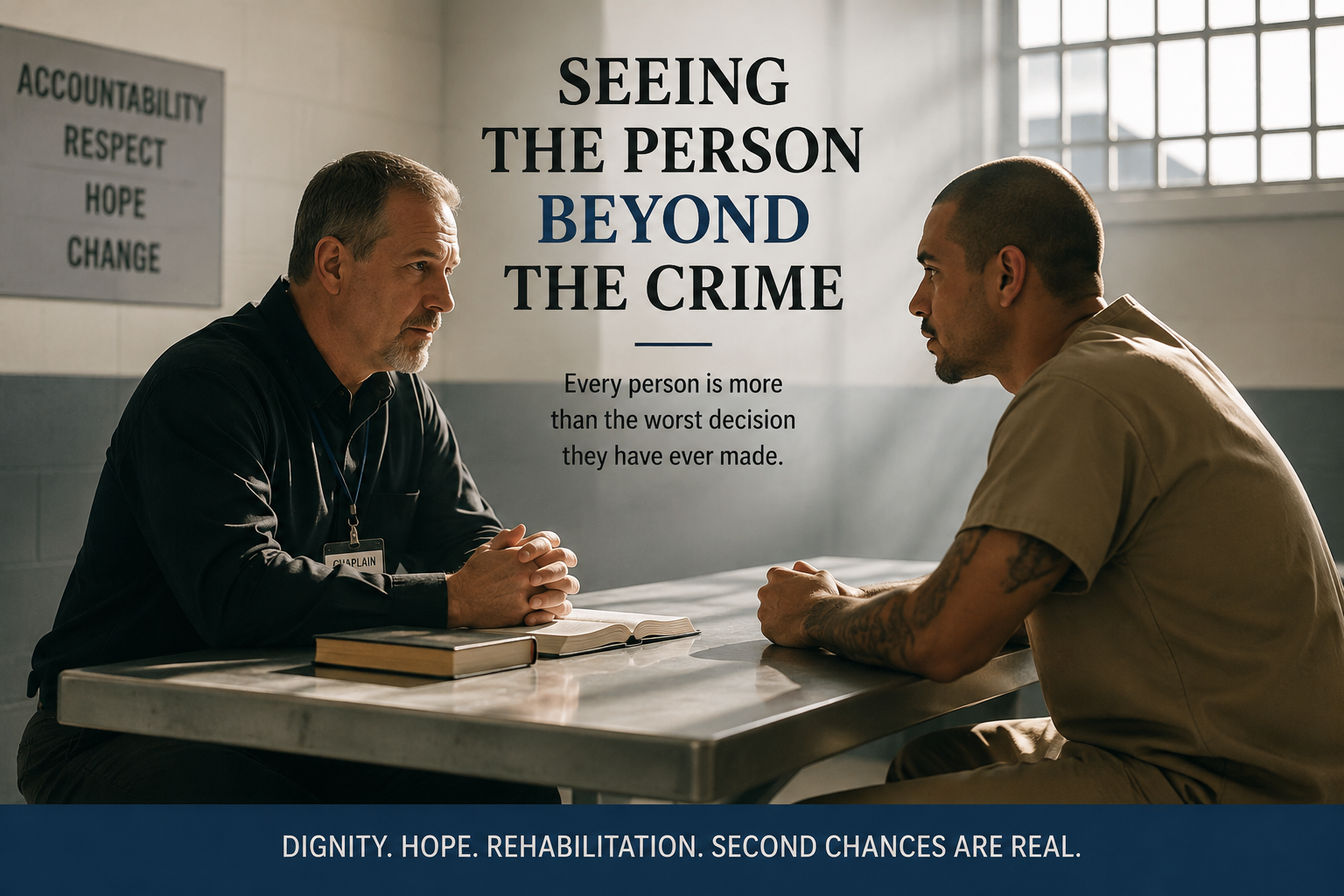
Working with people in custody forces chaplains to confront one of the most difficult questions in spiritual care: How do you genuinely care for someone whose actions have caused profound harm?
Correctional facilities house people convicted of offenses ranging from theft and fraud to assault, homicide, and sexual crimes. The suffering experienced by victims and their families is real and should never be minimized. Justice matters. Accountability matters. Nothing about compassionate spiritual care requires overlooking the seriousness of criminal behavior.
If rehabilitation is truly our goal, we must remember that every person in custody remains far more than a case number, conviction, or sentence. One of the foundational principles of chaplaincy is that a person's humanity cannot be reduced to the worst thing they have ever done. While terms such as inmate, prisoner, or offender accurately describe a person's legal status, they should never become the sum of that person's identity.
It is difficult to help someone build a new life if every interaction reinforces that they will forever be defined by their past. You cannot expect someone to respect themselves enough to pursue genuine change if you do not respect them enough to see beyond the worst thing they have ever done.
Whether an individual identifies as Christian, Jewish, Muslim, Buddhist, Hindu, follows another faith tradition, or claims no religious belief at all, every person enters the correctional system carrying questions that punishment alone cannot answer. Questions about guilt. Shame. Identity. Forgiveness. Regret. Meaning. Hope. Purpose. Whether change is actually possible. Whether or not they can truly become someone new.
Those questions are spiritual even when they are not overtly religious.
One of the greatest misconceptions about correctional chaplaincy is that the work centers primarily on religion. In reality, it centers on people. Chaplains help people in custody explore the beliefs, values, relationships, and sources of hope that shape how they understand themselves and their future. For some, that involves Scripture and Christian discipleship. For others, it involves reconnecting with the teachings of their own faith tradition. Still others simply need someone willing to ask difficult questions without reducing them to a conviction, a sentence, or a correctional identification number.
Effective correctional ministry also requires holding two truths in tension.
The first is discernment. Correctional professionals quickly learn that manipulation exists inside prisons. Healthy boundaries, institutional policies, and appropriate skepticism protect both staff and those in custody. Compassion is never the same thing as naïveté.
The second is hope. Years spent inside correctional institutions can tempt professionals to believe that people never truly change. Yet correctional history repeatedly demonstrates otherwise. While not every person in custody embraces transformation, many do. Some reconcile with estranged families. Others pursue education, confront addiction, accept responsibility for the harm they have caused, or develop a moral framework that reshapes the course of their lives. Lasting change is never guaranteed, but neither should it be dismissed. The system should be committed to providing the tools for someone in the system to begin the work.
One of the most important conversations chaplains facilitate involves helping people distinguish consequences from identity.
The consequences of criminal behavior often remain for life. A sentence may continue. Relationships may never be restored. Victims may continue to live with lifelong trauma. None of those realities disappear simply because an individual experiences remorse or personal transformation.
At the same time, living forever under the belief that one is nothing more than a criminal rarely produces growth. Genuine rehabilitation begins when people accept responsibility for their actions while also believing they are capable of becoming something more than the person who committed the offense.
That process looks different across religious traditions. A Christian may speak of repentance and redemption through Christ. A Jewish person may focus on teshuvah, the work of returning and making things right where possible. A Muslim may emphasize sincere repentance (tawbah) and renewed obedience to God. Buddhists may frame transformation through mindfulness, ethical living, and freedom from destructive patterns. Others may draw upon entirely secular moral frameworks grounded in personal responsibility and restorative justice. Although the language differs, many traditions recognize that human beings are capable of moral growth while remaining accountable for the harm they have caused.
For chaplains, the goal is not to erase those differences but to understand them well enough to care for people with integrity. Professional chaplaincy does not require abandoning one's own faith. It requires serving every person with equal dignity, regardless of whether they share that faith.
Perhaps that is the greatest lesson correctional ministry teaches.
Every person in custody has a story that began long before the crime for which they were convicted. Every victim has a story that deserves to be remembered. Justice requires that we never confuse compassion with excuse. Compassion also requires that we never confuse accountability with hopelessness.
The work of the correctional chaplain lives in that difficult space between justice and mercy. It is there, often behind locked doors and razor wire, that some of the most profound conversations about guilt, forgiveness, responsibility, and hope take place. Whether those conversations are rooted in Christianity, another faith tradition, or a search for meaning itself, they remind us that authentic spiritual care begins with a simple conviction: every person deserves to be treated as a human being, not merely as the worst decision they have ever made.
