The Cruel Companion of Grief: Living With the “What Ifs
One of the hardest parts of grief is that it seldom arrives by itself. Along with the loneliness and heartache often comes something else: questions. They usually begin with two simple words—what if?
What if we had chosen a different doctor? What if we had started treatment sooner? What if we had waited? What if we had said something different during our last conversation? What if I had made another decision?
Those questions have no easy answers, yet they can become as painful as the loss itself. They are the questions families carry into sleepless nights and quiet afternoons. They replay conversations, revisit decisions, and imagine different endings to stories that can no longer be rewritten.
I met one woman who was carrying that burden.
Muriel was eighty-five years old and living in an assisted living facility where she and her husband had shared a room for several years. They had been married for sixty-seven years. Mickey had spent most of his life as a Maine lobsterman. Even into his eighties he was still hauling lobster traps a few days each week. He was the kind of man who measured life by the weather, the tides, and the work that still needed to be done.
Then a small lesion appeared near his eye.
It seemed insignificant at first, but it continued to grow until doctors diagnosed an aggressive form of melanoma. Treatments began, and by every indication it seemed to be working. According to Muriel, the tumor had stopped growing—or so the doctor had said—and a surgeon believed it could be removed.
Mickey, however, wasn't convinced.
Surgery wasn't what he wanted. Leave it alone, he had said. Muriel, the doctors, and the rest of the family believed it offered his best chance. Eventually he agreed.
After the surgery things did not unfold as everyone had hoped. The cancer advanced rapidly, and about a month or so afterwards, Mickey entered hospice care.
I visited him three times before he died.
Despite the disease that had consumed much of the right side of his face, his spirit remained surprisingly steady. He talked about the years he had spent on the water and joked about Muriel being off at bingo while he was stuck in bed. When I asked how he was feeling, he shrugged and replied, "I've been better, but what're you gonna do?"
Three weeks later, he was gone.
A few days after his death, one of our hospice nurses asked if I would visit Muriel. She knew the family well and was concerned about how she was coping.
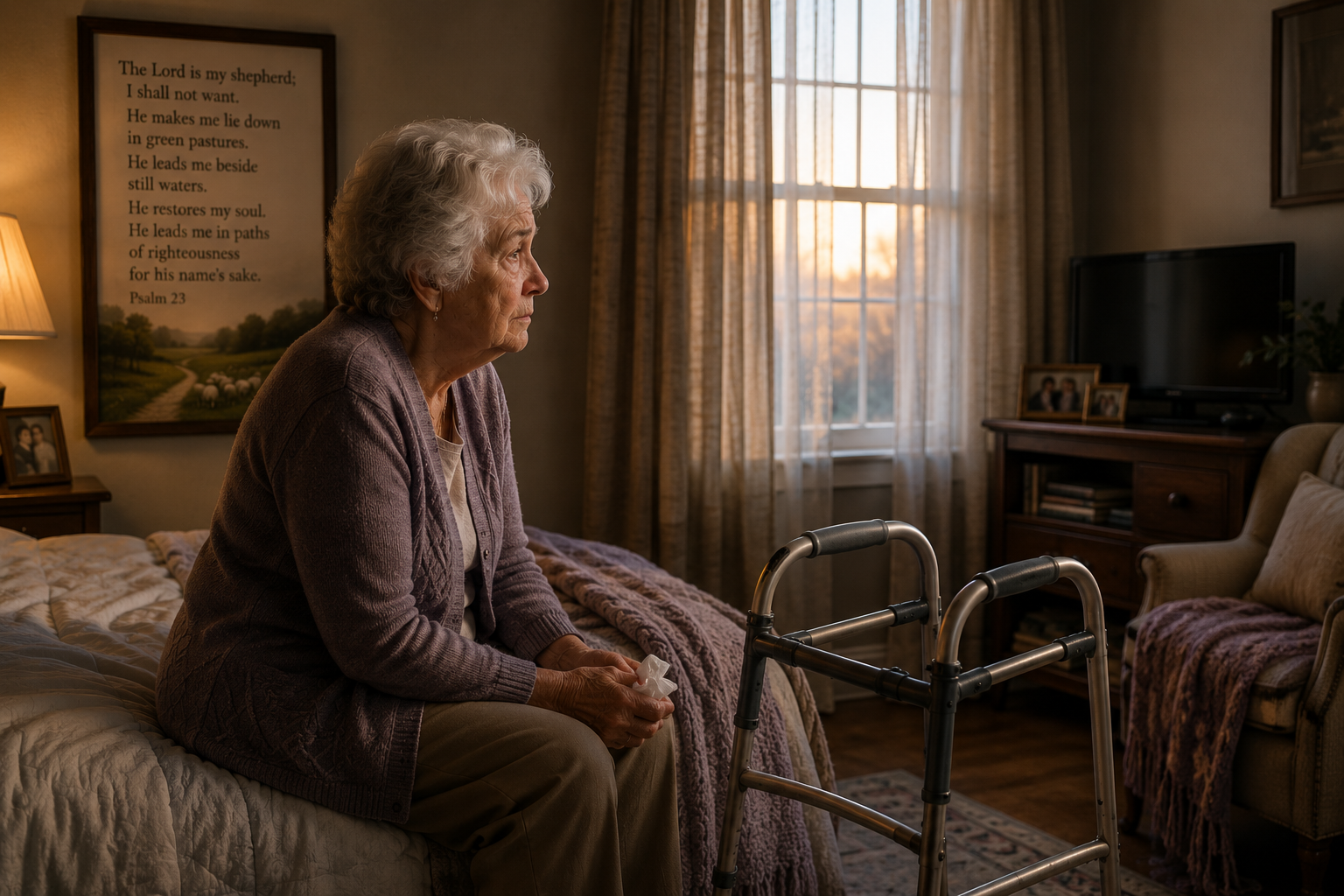
When I entered her room, she was sitting on the edge of her bed, leaning against her walker while the television played quietly in the background. I wasn't sure she was even watching it. Her eyes were red and swollen from crying, and a tissue remained clenched in her hand.
I knocked softly before stepping inside.
When she noticed me, her expression changed in the familiar way grief sometimes reveals itself. It was the look people get just before tears return. I walked over, sat beside her, and smiled.
She wiped her eyes, took a slow breath, and tried to compose herself. There was no need to hurry her. Silence is not an interruption to pastoral care. Sometimes it is part of the care itself.
Finally I asked, "Remember me, Muriel?"
She smiled faintly. "Of course I do."
We talked briefly about our nurse, Michelle, and how grateful she was for the care hospice had provided to her husband. A silence soon settled over the room.
When she finally spoke again, I asked the simplest question I knew, "How are you doing, Muriel"
She looked down at the tissue in her hands. "I'm doing okay. I have my moments."
"It's okay to have those moments," I said gently. "Those tears are yours. You don't have to hide them."
She nodded. "I seem to be having a lot more crying moments than good moments. But he was so sick. I'm glad he's not suffering anymore..."
She stopped and looked at me sadly. Then she said something that had clearly been weighing on her ever since her husband.
"I wish he'd never had that surgery. Everything changed after surgery," she said sadly.
As our visit wore on it became evident that she believed she had persuaded the man she loved to undergo an operation he never wanted. Now she wondered whether that decision had cost him his life.
I knew there was no way for me to answer the question she was really asking.
None of them could’ve known what would have happened if they had refused surgery. No physician could replay history. No family member could undo a decision made months earlier with the best information available at the time.
One of the great temptations in pastoral ministry is to answer questions that have no answer. We search for explanations because explanations make us feel useful and provide comfort to those we are sitting with. Yet explanations offered too quickly often become little more than attempts to quiet our own discomfort.
Some questions are not meant to be solved, just carried.
As Muriel continued talking, it became clear that she wasn't asking me for a medical opinion. Nor was she looking for someone to evaluate the surgeon or second-guess the treatment plan. She needed permission to say out loud what had been haunting her since her husband's death, and she feared would haunt her the rest of her life.
She loved him and had wanted what she believed was best for him. Now she was afraid that her love had somehow harmed the man she had spent sixty-seven years trying to protect.
How many husbands and wives have carried that same burden? How many sons and daughters have wondered if they should have started hospice sooner, waited longer, chosen another hospital, gotten a second opinion, or agreed to just one more treatment?
Those questions become part of grief because love always wonders if it could have done more.
Most families do the very best they can with the information they have. Decisions are made after conversations with physicians, prayer, thoughtful discussion, and genuine concern for the person they love. They are not made with the benefit of hindsight, nor can they be.
Hindsight is the cruel companion of grief. It compels us to judge yesterday with knowledge we did not possess yesterday.
That afternoon I couldn't tell Muriel why events had unfolded the way they did. I couldn't erase her questions or assure that refusing surgery would’ve brought an outcome that kept her husband with her. What I could do was sit with her in the middle of those unanswered questions and remind her that love had shaped every decision she and Mickey had made together.
Sometimes that’s all we have, and sometimes that’s enough. Not because the questions disappear, but because they no longer have to be carried alone.
Pastoral ministry is not about having the right answers. It is about being willing to remain present when there are no answers at all. Grief often asks questions that neither medicine nor theology can fully explain. In those moments, our calling is not to solve the mystery but to bear witness to God's presence in the midst of it.
There are questions this side of heaven we may never be able to answer.
There is also a God who remains faithful, even when all we can do is trust Him with the questions we cannot.
